Have you ever walked out of a Korean job interview feeling like you answered every question correctly, but somehow still sensed something was off? You are not imagining it. In our work helping foreign job seekers land offers with Korean companies, this is one of the most common feelings people describe to us, and it almost always comes down to one thing: Korean interview culture runs on a different set of unspoken rules than the ones most foreign candidates grew up with.
A great resume, like the one covered in our guide on Korean-style resumes versus English resumes, can get you in the door. But the interview itself is where Korean companies are really evaluating something Western interviews rarely test directly: whether you understand how to fit into a Korean team, a Korean reporting structure, and a Korean way of communicating respect. This guide walks through what to actually expect, the questions that come up again and again, and how to answer them in a way that reads as prepared rather than rehearsed.

Before the Interview: What Korean Recruiters Expect You to Prepare
Korean companies typically move faster between resume screening and interview than many Western employers, so preparation time is often short. In our experience, candidates who treat the week before a Korean interview as research time consistently outperform candidates who simply rely on general interview skills.
At minimum, be ready to speak to three things: the company’s recent news (a product launch, an expansion, a partnership), where the specific team you are interviewing for fits into the larger organization, and a clear, honest answer for why you want to work in Korea specifically, not just why you want this type of job. Korean interviewers ask this last point directly far more often than Western interviewers do, because they are trying to gauge whether you are likely to stay.
Business Consultant’s Note: We worked with a marketing candidate who had strong industry experience but kept getting rejected after first interviews. When we reviewed her answers, we realized she had never once mentioned why Korea, specifically, mattered to her. Once she added a genuine, specific reason tied to her career goals, her callback rate changed almost immediately.
Common Questions in a Korean Job Interview (and What They Are Really Asking)
Many of the individual questions in a Korean interview will sound familiar. What differs is what the interviewer is actually listening for underneath the question. Below are questions that come up in the large majority of Korean corporate interviews we have prepared candidates for.
“Please introduce yourself” is almost always the opening question, and it is rarely a request for your resume read aloud. Korean interviewers are listening for how you organize your own story, how confidently you speak about yourself without sounding boastful, and whether your self-introduction naturally leads into why you fit this specific role.
“Why did you apply to our company?” is a test of research, not enthusiasm alone. A vague answer about company reputation or salary will land poorly. Interviewers want a specific detail: a product, a market position, a value the company is known for internally.
“How would your coworkers describe you?” is used to assess team fit, since Korean workplaces still place significant weight on how smoothly a new hire will integrate into an existing team and reporting line. A safe, honest answer that includes both a strength and something you are actively working on tends to land better than an answer that only lists strengths.
“Are you comfortable working overtime or on a tight deadline?” comes up more often in Korean interviews than in many Western ones, reflecting a workplace culture where flexibility around hours is still commonly expected, even as the 52-hour workweek law has changed the legal baseline. Answering honestly, while showing willingness to be a team player during genuinely busy periods, is usually the right balance.
Group Interviews and Panel Format: A Uniquely Korean Practice
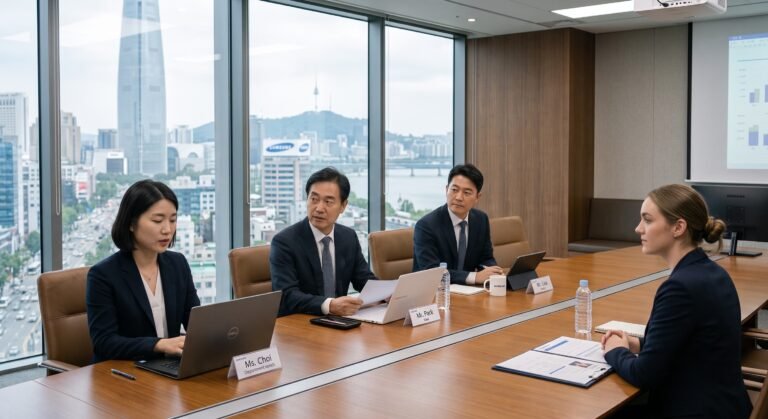
One structural difference catches many foreign candidates off guard: Korean companies frequently interview several candidates together in the same room, answering the same questions in turn, in front of a panel of three to five interviewers rather than one. This format is especially common at large corporations during their structured hiring seasons.
In a group interview, how you listen matters almost as much as how you answer. Interrupting another candidate, visibly reacting to their answers, or rushing to speak first can all be read as poor teamwork instincts, which is exactly what the format is designed to surface. We generally advise candidates to treat their turn as one part of a shared conversation rather than a competition to outshine the person next to them.
Panel interviews, whether group or one-on-one, also tend to include a mix of interviewers: a hiring manager evaluating job fit, an HR representative evaluating culture fit, and occasionally a senior executive asking one or two pointed questions near the end. Directing your answers to the whole panel, not just whoever asked the question, is a small habit that reads well in this format.
Etiquette That Can Make or Break a Good Answer
Content matters most, but in a culture where first impressions carry real weight, etiquette missteps can undercut even a strong answer. A slight bow when entering the room, waiting to be shown to your seat rather than sitting down immediately, and offering or receiving a business card with both hands are all small gestures that Korean interviewers notice, even if they never mention them directly.
Eye contact is another area where instincts can work against you. Prolonged direct eye contact with a senior interviewer can come across as challenging rather than confident in a Korean context. Steady, comfortable eye contact that naturally breaks and returns, the way it would in a respectful conversation with someone more senior, tends to read better than the unbroken eye contact often coached in Western interview prep.
Business Consultant’s Note: A client once told us he was confused after an interview that he felt went well on content, but the recruiter’s feedback mentioned he seemed “a bit strong” in his delivery. After talking it through, it became clear the issue was not his answers. It was that he kept firm, unbroken eye contact with the most senior person in the room the entire time, which read as confrontational rather than confident.
How to Talk About Salary, Visa Status, and Notice Period Without Sounding Awkward
Foreign candidates often worry about how directly to raise practical questions, but Korean interviewers generally expect these topics to come up, especially visa status. If you are on an E-7 or another employment-based visa, be ready to state your current visa type clearly and confirm you understand the sponsorship process, since HR teams are often screening for this as much as for skill fit. For a refresher on landing that sponsorship in the first place, see our guide on foreigner-friendly job platforms in Korea.
Salary is more sensitive. Korean companies frequently ask your expected salary directly, and an evasive answer can read as unprepared rather than diplomatic. A researched range, framed as flexible and based on the responsibilities of the role, is generally the safest approach. Avoid naming a hard minimum this early unless directly pressed.
Notice period questions are usually straightforward and simply logistical. If you are currently employed, stating your contractual notice period clearly, along with a general sense of your earliest possible start date, is enough. Korean HR teams are used to working around a standard one-month notice period and rarely expect an immediate start. For an overview of where to look for your next opportunity, our guide to Korea’s top job search platforms is a useful starting point.
Interview Prep Checklist: What to Confirm Before You Walk In
- Company: One recent news item and one specific reason you want to work there
- Role: How the team fits into the larger organization chart
- Self-introduction: A two-minute version, practiced out loud, not just written down
- Visa: Your current visa type and sponsorship understanding, ready to state clearly
- Salary: A researched range, not a single fixed number
- Etiquette: Business cards ready, a light bow prepared, seating instructions expected
- Language: Confirm in advance whether the interview will be in Korean, English, or both
Western Interview Norms vs. Korean Interview Norms
| Area | Typical Western Expectation | Typical Korean Expectation |
|---|---|---|
| Opening question | Brief background summary | Structured self-introduction, often 1-2 minutes |
| Interview format | Usually one-on-one | Frequently panel or group format |
| Eye contact | Steady, unbroken with interviewer | Respectful, softer with senior staff |
| Company research | Helpful but sometimes light | Expected in specific detail |
| Salary discussion | Often deferred to later rounds | Frequently raised directly, early on |
| Overtime questions | Less common | Common, tied to workplace flexibility expectations |
Frequently Asked Questions
Do I need to speak Korean fluently for a job interview in Korea?
Not always. Many multinational companies and tech firms in Korea interview primarily in English, but you should confirm the interview language in advance with HR rather than assume.
Is it rude to ask about salary in a Korean job interview?
No, it is generally expected. Korean interviewers often ask directly, and having a clear, researched salary range ready is seen as prepared, not presumptuous.
What should I do if I am interviewed alongside other candidates?
Focus on giving a clear, complete answer during your turn and listen respectfully while others answer. Avoid interrupting or visibly reacting, since group interviews are partly designed to observe teamwork behavior.
How should I explain a visa sponsorship need during the interview?
State your current visa status plainly and confirm you understand what sponsorship or a visa change would involve. Most Korean HR teams handling foreign hires are familiar with this process and will not be caught off guard by the question.
Should my answers be different for a large company versus a startup?
Yes, to some degree. Large Korean corporations tend to favor more structured, formal answers, while startups and foreign-invested companies often value directness and a more conversational tone, closer to a Western-style interview.
Getting the interview is often the hardest part, and understanding how Korean companies actually evaluate candidates in the room is what turns that opportunity into an offer. If you would like a second pair of eyes on your interview prep, help understanding a specific company’s hiring process, or guidance on visa sponsorship questions before you walk in, AMP Interpro’s Global HR & Recruiting team can help. Get in touch here.