
If you’ve ever sat across from a founder who just landed in Seoul with a laptop, a business plan, and no idea where to start, you know the look. It’s a mix of excitement and panic. Korea is genuinely one of the easiest OECD countries to incorporate in on paper — but “on paper” and “in practice” are two very different things once immigration, banking, and tax offices get involved.
I’ve walked dozens of foreign founders and HR managers through this process, and almost every client asks the same question in their first meeting: “Can I really own 100% of a Korean company?” The short answer is yes. The longer answer — the one that actually keeps your business open past year one — is what this guide to business registration in Korea is about.

Why “Just Register a Company” Never Works Alone
Foreign entrepreneurs often treat business registration in Korea as one form, one office, one afternoon. In reality, it’s three separate government systems working together: corporate law (court registry), tax law (National Tax Service), and immigration law (Ministry of Justice). Miss one, and the other two don’t matter.
I once worked with a European client who registered his corporation and opened a bank account within two weeks — impressively fast. But he’d skipped the foreign investment notification step entirely. Six months later, when he applied for his D-8 investor visa, immigration flagged the company as “not properly recognized” as foreign-invested, and the whole visa application stalled for another three months while we retroactively fixed the paperwork. The lesson for business registration in Korea: sequence matters as much as the individual steps.
Choosing the Right Business Structure
Most foreign investors handling business registration in Korea choose one of two entity types:
- Yuhan Hoesa (limited liability company): The most common choice for smaller, closely held foreign businesses. One director and one shareholder of any nationality is enough, and there’s no statutory minimum capital for the entity type itself.
- Jusik Hoesa (stock company): Preferred by investors planning to raise outside capital later, bring on multiple shareholders, or eventually list. It requires a more formal board structure once capital passes certain thresholds.
A branch office or liaison office is also possible if you’re extending an existing overseas company into Korea rather than starting fresh — useful for HR managers setting up a regional presence rather than a standalone startup.
The KRW 100 Million Rule and Foreign Investment Notification
This is the number every foreign investor needs to know for business registration in Korea: KRW 100 million (roughly USD 70,000–75,000). Under Korea’s Foreign Investment Promotion Act, an investment only counts as recognized “foreign investment” if it meets two conditions together — the amount is at least KRW 100 million, and the foreign investor holds at least 10% of voting shares.
Why does this matter so much? Because being recognized as a “foreign-invested company” is what unlocks:
- Eligibility for the D-8 corporate investment visa
- Certain tax incentives and simplified customs treatment in some sectors
- Legal standing to bring in the capital as a genuine equity investment rather than an unclear cash transfer
The notification itself is filed with a bank or KOTRA (Korea Trade-Investment Promotion Agency) before the funds are wired in — not after. I’ve seen founders wire the money first and try to paper over the notification later; it’s fixable, but it adds weeks and invites more scrutiny from immigration down the line.
Corporate Registration vs. Business Registration in Korea (They’re Not the Same)
This is the single most common confusion I run into, so let me separate the two clearly:
- Corporate registration (법인설립등기): Filed with the local court registry. This is what legally creates the corporation itself — its name, capital, directors, and registered address. Think of it as the company’s “birth certificate.”
- Business registration (사업자등록): Filed separately with the National Tax Service after the corporation exists. This is what allows the company to actually issue invoices, charge VAT, and operate legally as a taxpayer.
A company can be legally incorporated and still not be allowed to do business if this second step is skipped. I’ve had clients who assumed one covered the other — it doesn’t, and tax offices in Korea are not shy about penalizing companies that operated before registering as a business taxpayer.
If you’re also weighing whether to hold Korean assets personally or through your new company, our guide on corporate vs. individual property purchase in Korea walks through the tax and compliance trade-offs.
Getting the D-8 Visa Right
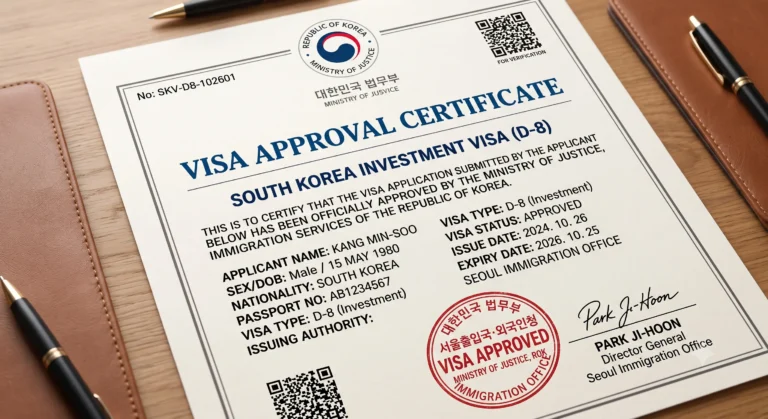
Once the company and investment are properly registered, most solo founders and dispatched executives need the D-8 corporate investment visa to legally live and work at the company they’ve built. The requirements sound simple: invest at least KRW 100 million, hold 10%+ of voting shares, and show the funds came from overseas.
In practice, immigration officers at HiKorea look at the whole package — the investment notification, the wire transfer route, the corporate registration, an actual office lease (a virtual address usually isn’t enough), and a credible business plan. I tell clients: the visa isn’t approved because you wired money. It’s approved because your paperwork tells one consistent story from bank transfer to boardroom. For related visa context, see our guide on the 2026 H-2 to F-4 visa change.
Common Mistakes I See Foreign Founders Make
- Splitting the investment between two passports. If two foreign co-founders each put in KRW 50 million, that does not meet the KRW 100 million threshold — each individual investor must independently clear it.
- Using a virtual office for the D-8 application. Immigration frequently requires evidence of an actual operating space, not just a registered address.
- Registering the corporation before completing the foreign investment notification. This creates a mismatch that has to be corrected later, usually with added delay.
- Assuming a Korean bank account opens automatically. Corporate banking for foreign-owned entities in Korea often requires in-person verification and can take longer than founders expect — plan for this early, not the week before payroll is due.
- Underestimating the business plan requirement. A vague plan without revenue projections or market research is one of the most common reasons D-8 applications get sent back for more documents.
Registration Steps at a Glance
| Step | What Happens | Handled By |
|---|---|---|
| 1. Foreign Investment Notification | Report the planned investment before wiring funds | Bank or KOTRA |
| 2. Fund Remittance | Wire capital from overseas, obtain currency purchase certificate | Korean bank |
| 3. Corporate Registration | Legally incorporate the company | Local court registry |
| 4. Business Registration | Register as a taxpayer to legally operate | National Tax Service |
| 5. Foreign-Invested Company Registration | Confirm foreign investment status | KOTRA / Invest Korea |
| 6. D-8 Visa Application | Apply for residence to manage the company | Ministry of Justice (immigration) |
Frequently Asked Questions
Q. Can a foreigner own 100% of a company in Korea?
Yes, in most industries a foreigner can hold full ownership. A small number of restricted sectors — such as broadcasting or nuclear power — require a Korean partner or cap foreign ownership.
Q. Do I need KRW 100 million to start any business in Korea?
No — you can incorporate a company with less capital. The KRW 100 million threshold only applies if you want the investment recognized as “foreign investment” under the Foreign Investment Promotion Act, which is generally required for the D-8 visa route.
Q. How long does the whole process take?
With clean documentation, corporate and business registration in Korea can often be completed within a few weeks, but the D-8 visa review adds additional time. Realistic total timelines usually run one to three months.
Q. Can I register a business without living in Korea yet?
Corporate registration itself can often be initiated with a Korean representative or through power of attorney, but the D-8 visa requires demonstrating you’ll be actively managing the company in Korea.
Q. What happens if I skip the foreign investment notification?
The company can still be registered, but it won’t be recognized as a foreign-invested company, which can block D-8 visa eligibility and certain investment incentives. It’s usually correctable, but it costs time.
The Bottom Line
Registering a business in Korea as a foreigner isn’t complicated because any single step is hard — it’s complicated because three different government systems have to agree with each other, in the right order. Get the sequence right, and most of the friction disappears.
This is exactly the kind of process where a second set of experienced eyes saves months, not days. At AMP Interpro, our Business Setup & Marketing team walks foreign entrepreneurs and HR teams through the entire path — from the foreign investment notification through corporate registration, business registration in Korea, and the D-8 visa application — so you’re not learning the hard way. If you’re planning to set up in Korea, reach out to AMP Interpro and let’s map out your specific path before you wire a single won.
Disclaimer: Regulations under the Foreign Investment Promotion Act and immigration rules change periodically. Please confirm current requirements with KOTRA/Invest Korea or the Ministry of Justice (HiKorea) before filing.





3 Comments