
Have you ever wondered why so many linguists and language enthusiasts are fascinated by the Korean writing system? Let me introduce you to the Hangul Korean Alphabet, a true marvel of linguistic design that combines beauty, logic, and efficiency in ways that continue to impress scholars worldwide.
The Genius Behind the Hangul Korean Alphabet
Unlike most writing systems that evolved gradually over centuries, Hangul was deliberately created in the 15th century by King Sejong the Great. What makes this story remarkable is not just the creation itself, but the thoughtful scientific principles behind each letter.
Ever noticed how when you pronounce “g” or “k,” your tongue blocks the back of your throat? Look at the Korean letter ‘ㄱ’ (g/k sound) – its shape actually mimics the position of your tongue when making that sound! This pattern continues throughout the alphabet, with consonants designed to reflect the shape of your vocal organs when pronouncing them.
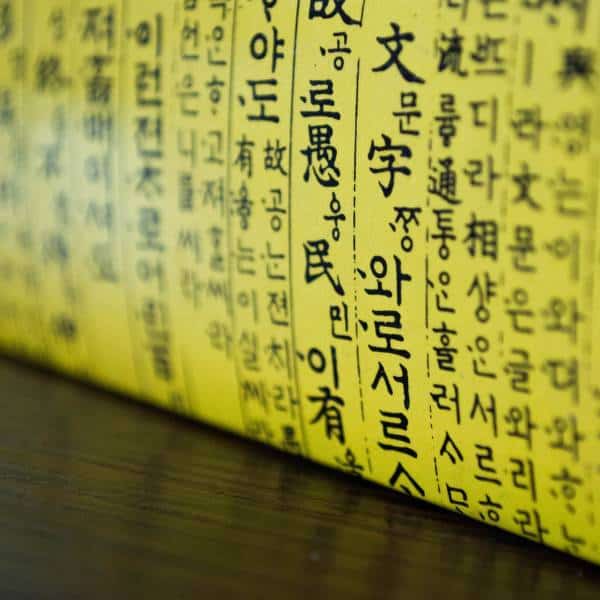
Building Blocks of Sound
Hangul isn’t just a collection of symbols – it’s a system of building blocks. The basic letters combine into syllable blocks, creating a visual harmony that’s both practical and aesthetically pleasing. For example:
한 (han) = ㅎ + ㅏ + ㄴ
글 (gul) = ㄱ + ㅡ + ㄹ
This modular design allows for incredible flexibility while maintaining perfect phonetic representation. Unlike English with its notorious spelling inconsistencies (think “though,” “through,” and “tough”), Hangul provides clear, consistent guidance on pronunciation.
Easy to Learn, Hard to Master
One of Hangul’s most remarkable features is its accessibility. The basic alphabet can be learned in just a few hours – something that’s nearly impossible with Chinese characters or Japanese kanji. Yet within this simple framework lies surprising depth, as letters combine in systematic ways to represent the full range of Korean sounds.
A popular Korean saying claims: “A wise man can acquaint himself with Hangul before the morning dew has dried.” While perhaps a bit optimistic, it speaks to the intuitive design that makes initial learning remarkably straightforward.
For those who grew up speaking Korean as their native language, learning Hangul naturally came without much difficulty. But for foreigners encountering the Korean language for the first time, everything about it can feel completely unfamiliar, and mastering Hangul is honestly not always an easy task. Still, King Sejong the Great, who first invented Hangul, created it specifically so that ordinary people could easily learn, understand, and use written language. Because of this original purpose, Hangul contains scientific principles that allow even first-time foreign learners to become proficient quickly with just a little interest and practice, so it’s genuinely worth giving a try. And of course, as with any language, the deeper you study Hangul, the more you discover how rich its expressions are and how they vary depending on cultural and historical context, so it is also true that the deeper you go, the more challenging it becomes.
Digital Superstar
In our modern digital world, Hangul has proven exceptionally adaptable. Its systematic structure makes it perfect for digital processing, typing, and display. The syllabic blocks are easily represented in computer systems, and the logical structure makes text prediction and processing highly efficient.
This digital-friendliness has helped Korean technology companies lead in areas like mobile communications and online services, where language processing is crucial.
UNESCO Recognition and Cultural Pride
The brilliance of Hangul hasn’t gone unnoticed. UNESCO registered the Hunminjeongeum (the original document explaining Hangul’s creation) in its Memory of the World Register, recognizing its cultural and historical significance.
Beyond being a practical tool for communication, the Hangul Korean Alphabet has become a source of immense cultural pride for Koreans. October 9th is celebrated as Hangul Day, a national holiday commemorating this unique cultural achievement.
Standing Out in a World of Writing Systems
When compared to other writing systems, the Hangul Korean Alphabet truly stands out:
- Unlike alphabets like Latin or Cyrillic, Hangul organizes letters into syllabic blocks
- Unlike Chinese characters, Hangul is phonetic rather than ideographic
- Unlike Japanese with its multiple scripts, Hangul maintains consistency
- Unlike most writing systems that evolved organically, Hangul was scientifically designed
This combination of features makes Hangul truly one-of-a-kind in the world of writing systems.
Why It Matters
As I’ve explored the Hangul Korean Alphabet throughout this piece, what strikes me most is how thoughtful design can create a writing system that’s simultaneously scientific, learnable, and culturally distinct. To me, Hangul’s significance reaches far beyond Korea’s borders — in an age where I feel we often take writing systems for granted, researching Hangul has reminded me that how we represent language is itself a profound act of innovation.
Whether you’re a language enthusiast, a design admirer, or simply curious about cultural innovations like I am, I hope this look into Hangul has offered you the same fascinating window I found into how human creativity can perfect the art of written communication.
Have you encountered Korean writing before? What aspects of Hangul’s design do you find most intriguing? I’d love to hear your thoughts in the comments below!