
If you’ve ever dreamed of working remotely from a Seoul café, wrapping up your workday and strolling along the Han River, that dream just got a whole lot more achievable.
On June 30, 2026, South Korea officially launched its Digital Nomad Visa — formally known as the F-1-D Visa, or “Workation Visa” — as a permanent immigration program. Following a two-and-a-half-year pilot that ran from January 2024 through May 2026, the Korean Ministry of Justice rolled out the full program with meaningfully relaxed eligibility requirements, a longer maximum stay, and expanded access for younger remote workers.
This guide covers everything you need to know: who qualifies, what changed from the pilot, how to apply step by step, what family members can come with you, and — critically for Americans — how your taxes work while you’re there.
What Is South Korea’s F-1-D Digital Nomad Visa?
The F-1-D Visa is a residency visa that allows foreign nationals employed by overseas companies to live in South Korea while continuing to work remotely for their foreign employer. It is fundamentally different from a traditional Korean work visa.
Unlike a work visa, which requires employment with a Korean employer, the F-1-D allows foreign nationals employed by overseas companies to live in Korea while working remotely.
In practical terms: if you work for a U.S. tech company, a European consulting firm, or run your own foreign-registered business, you can legally live in South Korea for up to three years — without needing to find a Korean employer, sign a local contract, or navigate a corporate sponsorship process.
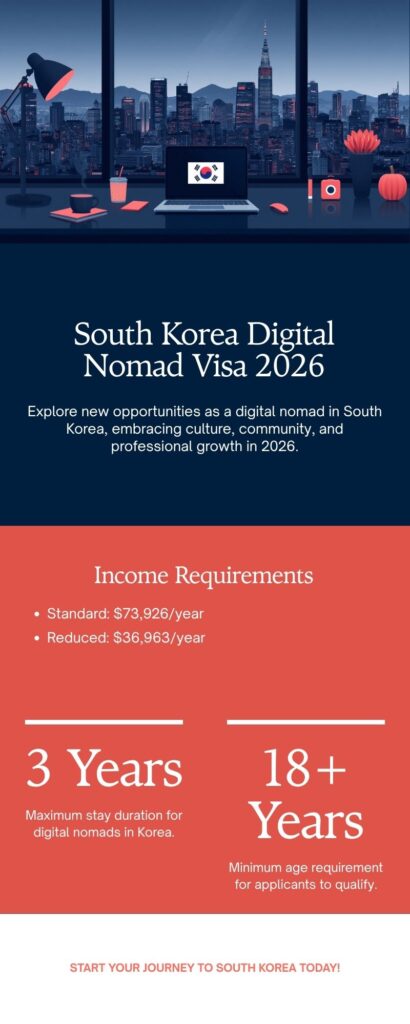
The program follows a pilot that ran from January 2024 to May 2026. It is open to foreign nationals aged 18 or above who have been employed by an overseas company — or owned a foreign business — for more than one year and are able to work remotely while residing in South Korea.
What Changed from the Pilot Program? — The Three Biggest Updates
Change 1: Lower Income Requirements — The Most Significant Shift
This is the headline change, and it matters enormously for who can now realistically qualify.
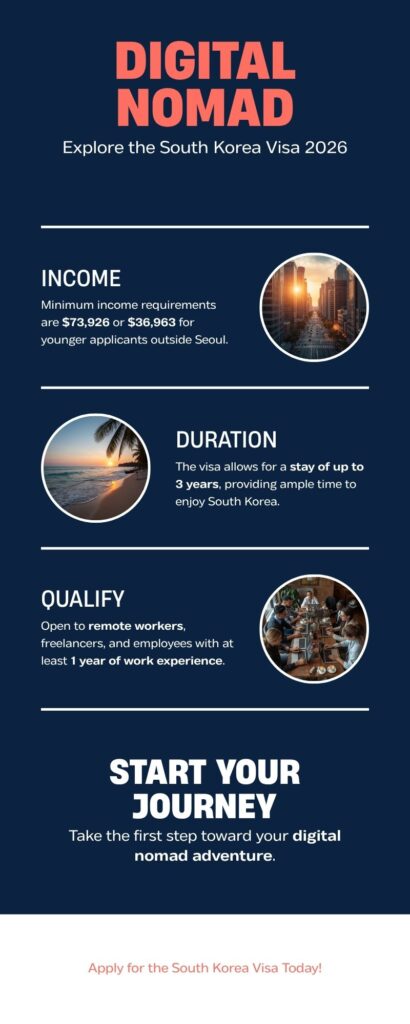
Under the pilot program, applicants were generally required to earn at least twice Korea’s previous year’s gross national income per capita. Under the new rules, however, lower income thresholds apply depending on factors such as age and whether applicants plan to reside outside the Greater Seoul area or in designated population-declining regions.
Here’s what that looks like in real numbers:
Standard threshold (Greater Seoul area or age 35+):
2x South Korea’s GNI per capita. Korea’s GNI per capita stood at $36,963 in 2025. That means the standard income requirement works out to approximately $73,926 per year.
Reduced threshold (ages 18–34, living outside Greater Seoul):
Applicants aged 18 to 34 who reside outside Seoul, Incheon, and Gyeonggi Province are eligible if they earn at least the previous year’s GNI per capita — rather than twice that amount. That brings the income floor down to approximately $36,963 per year — exactly half the standard requirement.
Additional incentives for population-declining regions:
The revised eligibility framework also supports wider regional development objectives. Applicants who intend to live outside the Greater Seoul metropolitan area or within designated population-declining regions benefit from the more flexible income thresholds introduced under the updated programme.
The policy logic here is clear. South Korea is using the Digital Nomad Visa not just to attract global talent, but to direct that talent toward cities and towns beyond the capital — addressing the country’s demographic challenges at the same time.
Change 2: Maximum Stay Extended from Two Years to Three Years
The maximum period of stay has also been extended from two years to three years.
Under the pilot, you could stay for one year with one renewal, capping you at two years total. Under the permanent program, that ceiling is raised to three years — giving remote workers a longer runway to settle in, explore the country, and decide whether they want to pursue longer-term residency.
Change 3: The Program Is Now Permanent
South Korea has officially made its digital nomad visa programme permanent from 30 June 2026.
During the pilot phase, a significant concern among prospective applicants was the uncertainty of the program’s future. That concern is now resolved. The F-1-D Visa is a permanent fixture of South Korea’s immigration framework, giving remote workers the confidence to plan a genuine long-term stay rather than treating it as a temporary experiment.



One Comment
Comments are closed.