If you’ve made it to this post, chances are you’ve already read through the basics of South Korea’s newly permanent F-1-D Digital Nomad Visa — the income thresholds, the three-year stay, the family inclusion, and why this program is worth taking seriously.
Now comes the part that actually matters: how do you complete your F-1-D visa application?
Understanding the visa is one thing. Walking through the front door is another. A lot of remote workers get excited about a new visa program, spend weeks reading about it — and then stall out when it comes to the actual paperwork. The requirements feel vague. The document list seems intimidating. And the question of whether to apply from home or from inside Korea adds another layer of uncertainty.
This post cuts through all of that.
Whether you’re sitting in the U.S. planning a move, currently traveling through Asia, or already on the ground in Korea on a tourist visa wondering if you can switch — this guide walks you through every step of the F-1-D application process in plain language, with no assumptions about what you already know.
By the time you finish reading, you’ll know exactly what documents to gather, in what order, where to submit them, what to expect during processing, and what to do once you arrive. Let’s get into it.
How to Complete Your F-1-D Visa Application — Step-by-Step
Step 1: Confirm Your Eligibility
Before gathering any documents, confirm two things. First, whether your income meets the applicable threshold based on your age and where in South Korea you plan to live. Second, whether your employment or business structure qualifies — your employer must be registered outside South Korea, and your work must be genuinely remote.
Step 2: Gather Your Documentation
Begin collecting your required documents. Because employment certificates and similar proof documents are only valid for three months from issuance, coordinate your gathering timeline so everything remains valid at the time of submission. Obtain your criminal background check early — apostille certification can take several weeks depending on your country.
Step 3: Choose Your Application Pathway
Applying from outside South Korea:
Visit the Korean Embassy or Consulate in your country of residence. Bring your complete document package and apply in person. Processing times vary by location.
Applying from within South Korea:
If you are currently in Korea, you can switch from the visa exemption (B-1), tourist visa (B-2), or short-term stay visa (C-3). Visit your local Immigration Office or the Hi-Korea immigration portal to initiate a change of status. You do not need to exit the country to make this switch.
Step 4: Submit and Wait for Processing
After submission, the immigration office will review your documents and may request additional materials. Respond promptly to any requests — delays in your response extend your processing timeline.
Step 5: Receive Your F-1-D Visa and Register as a Foreigner
Once your F-1-D visa application is approved, you’ll receive your F-1-D Visa. Upon entry or status change, you’ll need to register as a foreign national and obtain an Alien Registration Card (ARC) from the immigration office. Your ARC serves as your primary identification document in South Korea.
Tax Considerations for American Remote Workers
For U.S. citizens and permanent residents, living abroad does not eliminate your obligation to file taxes with the IRS. Here is what you need to understand before you go.
Foreign Earned Income Exclusion (FEIE)
From a U.S. tax perspective, your remote income from South Korea qualifies as foreign earned income, making you eligible for the Foreign Earned Income Exclusion — up to $130,000 for 2025 and $132,900 for 2026.
To claim the FEIE, you must meet either the Physical Presence Test (330 days outside the U.S. in any 12-month period) or the Bona Fide Residence Test. Given that the F-1-D Visa allows up to three years of residency, most digital nomads living in South Korea full-time will qualify.
Foreign Tax Credit (FTC)
If you become a South Korean tax resident — meaning you spend 183 or more days in the country — and pay Korean income taxes, you can claim a dollar-for-dollar credit against your U.S. tax bill. The U.S.-South Korea tax treaty helps prevent double taxation.
Self-Employment Tax — An Important Caveat
If you’re a freelancer or independent contractor, you still owe U.S. self-employment tax of 15.3% even if the FEIE eliminates your income tax. South Korea does not have a totalization agreement with the U.S., so you may need to pay into both countries’ social security systems.
This is a meaningful financial consideration for freelancers. Factor it into your cost-of-living calculations before committing to a long stay.
Bottom line: Consult a tax professional with experience in U.S. expat taxation before you relocate. The rules are navigable, but the consequences of getting them wrong are significant.
Why South Korea? — The Real Case for Remote Workers
Beyond the visa mechanics, the practical question is: why South Korea specifically?
Internet infrastructure: South Korea consistently ranks among the top countries globally for internet speed and reliability, with average speeds exceeding 100 Mbps. For remote workers who depend on stable, fast connectivity, this is a genuine competitive advantage over many other digital nomad destinations.
Cost of living: South Korea offers a cost of living roughly 20–25% lower than major U.S. cities. Housing, groceries, transportation, and healthcare are all meaningfully more affordable than New York, San Francisco, or Boston — while the quality of urban amenities is comparable or better in many respects.
Safety: South Korea ranks among the safest countries in the world across standard measures of personal security, crime rates, and infrastructure reliability.
Food, culture, and quality of life: Beyond the logistical advantages, South Korea offers one of the most vibrant urban cultures in Asia. From Seoul’s neighborhoods to the coastal energy of Busan, the traditional charm of Jeonju, and the natural scenery of Jeju Island, there is genuine variety in how and where you can build your daily life.
The regional opportunity: For applicants aged 18–34, living outside the Greater Seoul area does double duty. It cuts the income requirement in half — from $73,926 to $36,963 — and opens access to cities and regions that offer lower rents, smaller crowds, and a different quality of everyday life. Cities like Busan, Daejeon, Gwangju, and Gyeongju are genuinely worth considering, not just as workarounds for the income threshold, but as places worth living in their own right.
How Popular Is the Program Right Now?
According to Seoul Economic Daily, 398 registered foreign nationals were residing in South Korea under the digital nomad visa programme as of May 2026.
That number is modest. The primary reason is that the pilot program’s income threshold of approximately $73,926 excluded a significant portion of remote workers who would otherwise have been interested. With the reduced threshold now in place for younger applicants outside Greater Seoul, that number is expected to grow substantially in the coming months.
For those considering the visa, the relatively small current community also means less competition for housing, coworking spaces, and the broader support infrastructure that tends to cluster around expat and digital nomad communities. Getting in early has its advantages.
Key Information at a Glance
| Detail | Information |
|---|---|
| Visa Type | F-1-D (Workation / Digital Nomad Visa) |
| Official Launch Date | June 30, 2026 |
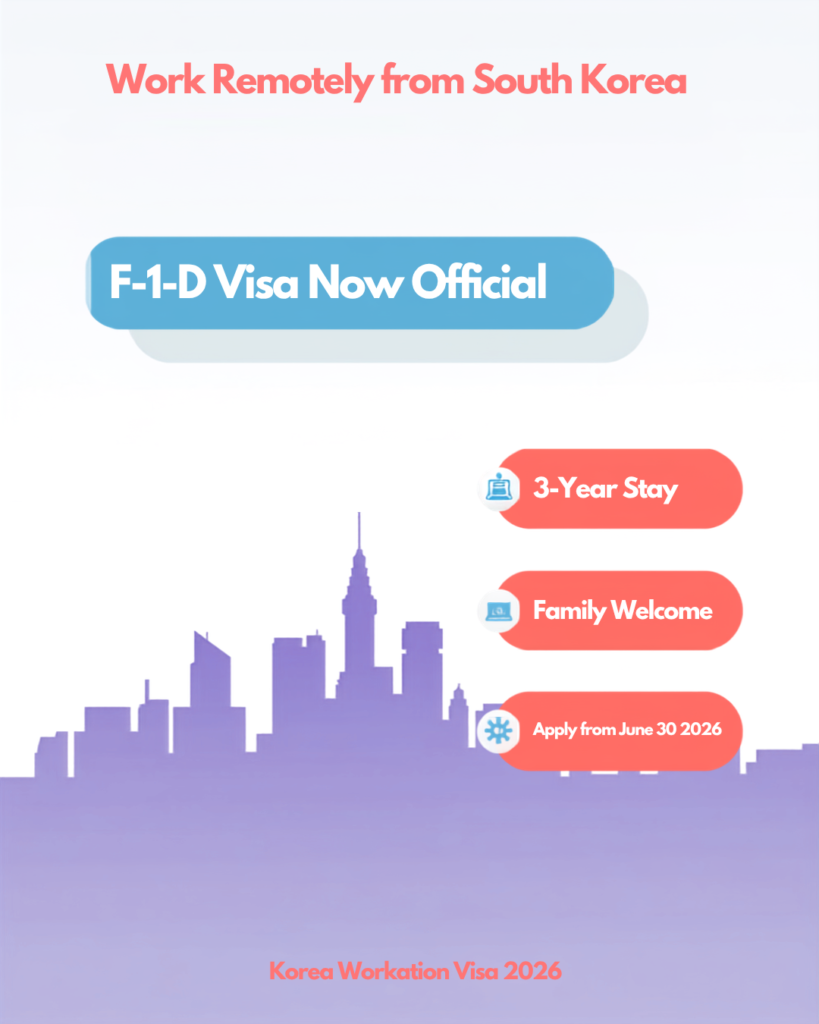
| Maximum Stay | 3 years (1 year + 1 renewal) |
| Standard Income Requirement | ~$73,926/year (2x GNI) |
| Reduced Income Requirement | ~$36,963/year (1x GNI) for ages 18–34 outside Greater Seoul |
| Family Members | Spouse and minor children eligible |
| Local Employment | Prohibited |
| Health Insurance | Minimum ₩100 million coverage required |
| Application Locations | Korean Embassy abroad or Immigration Office in Korea |