
If you’ve ever dreamed of working remotely from a Seoul café, closing your laptop, and strolling along the Han River at sunset — I’ve heard that dream from more clients than I can count. For a long time, my job was to manage expectations about how hard that dream actually was to reach. As of this year, I finally get to tell people it just got a lot more achievable.
On June 30, 2026, South Korea officially launched its Digital Nomad Visa — formally known as the F-1-D Visa, or “Workation Visa” — as a permanent immigration program. I tracked the two-and-a-half-year pilot that ran from January 2024 through May 2026 closely, because a good share of my caseload during that period involved clients trying to make sense of it. The Korean Ministry of Justice has now rolled out the full program with genuinely relaxed eligibility requirements, a longer maximum stay, and expanded access for younger remote workers.
What follows is the same breakdown I give clients in a first consultation: who qualifies, what changed from the pilot, how the application actually works step by step, which family members you can bring, and — the part that trips up nearly every American I advise — how your taxes work once you’re living there.
Consultant’s Note: Before we go further, here’s the single biggest misconception I correct in almost every first meeting: this is not a Korean work visa. You’re not being sponsored by a Korean employer, and you should never treat it that way. If a client tells me they’re planning to pick up local freelance work “on the side” once they land, I stop them right there — that’s a fast way to jeopardize your status.
What Is South Korea’s F-1-D Digital Nomad Visa?
Here’s how I explain it to clients: the F-1-D is a residency visa that lets you live in Korea while continuing to work for the employer or business you already have back home. It’s fundamentally different from a traditional Korean work visa, and that distinction matters more than most applicants realize going in.
Unlike a standard work visa, which ties your legal status to a Korean employer, the F-1-D keeps your employment relationship exactly where it is — overseas. In practical terms: if you work for a U.S. tech company, a European consulting firm, or run your own foreign-registered business, you can legally live in South Korea for up to three years — without ever needing to find a Korean employer, sign a local contract, or navigate a corporate sponsorship process.
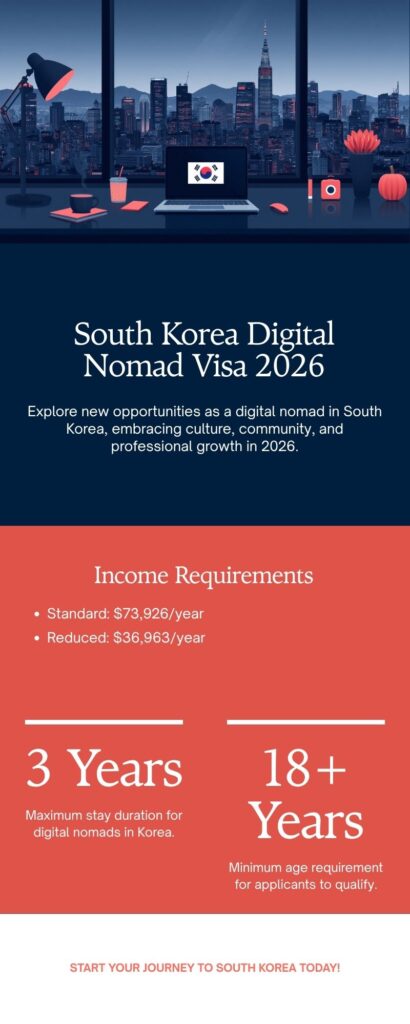
The eligibility framework carries over from the pilot that ran January 2024 to May 2026. To qualify, you need to be 18 or older, have worked for — or owned — an overseas company for more than a year, and be able to genuinely perform that work remotely while residing in South Korea.
Consultant’s Note: The phrase “able to work remotely” sounds simple, but it’s where I see applications stumble. Immigration officers want real evidence — an employer letter explicitly confirming a remote work arrangement, not just a job title that could plausibly be remote. I always tell clients to get this letter drafted and signed before starting the rest of the paperwork, because chasing it down later, under a deadline, is where people lose weeks.
What Changed from the Pilot Program? — The Three Biggest Updates
Change 1: Lower Income Requirements — The Most Significant Shift
This is the change my clients ask about first, and honestly, it’s the one that determines whether most people qualify at all.
Under the pilot, you generally needed to earn at least twice Korea’s previous year’s gross national income per capita — a bar that quietly excluded a lot of younger remote workers and freelancers I spoke with. Under the new rules, that threshold flexes based on your age and where in Korea you plan to live.
Here’s how I break the numbers down for clients:
Standard threshold (Greater Seoul area or age 35+):
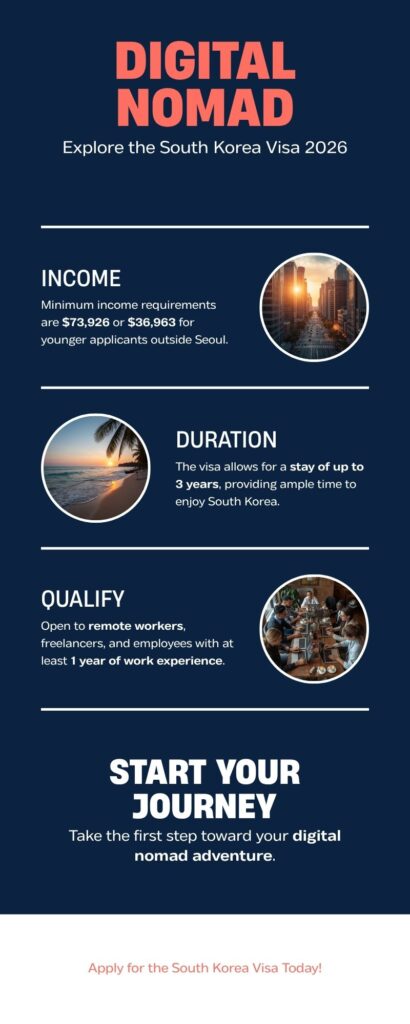
2x South Korea’s GNI per capita. Korea’s GNI per capita stood at $36,963 in 2025. That means the standard income requirement works out to approximately $73,926 per year.
Reduced threshold (ages 18–34, living outside Greater Seoul):
Applicants aged 18 to 34 who reside outside Seoul, Incheon, and Gyeonggi Province are eligible if they earn at least the previous year’s GNI per capita — rather than twice that amount. That brings the income floor down to approximately $36,963 per year — exactly half the standard requirement.
Additional incentives for population-declining regions:
If you’re planning to settle outside the Greater Seoul metropolitan area, or within one of the designated population-declining regions, you get access to these more flexible income thresholds as well.
What I tell every client is that this isn’t a random policy quirk. South Korea is deliberately using this visa to pull global talent toward smaller cities and towns beyond the capital — addressing the country’s demographic challenges at the same time. If you’re flexible on location, use that to your advantage.
Consultant’s Note: I’ve had younger clients miss the reduced threshold simply because they didn’t realize their intended address counted against them. Before you commit to an apartment or a neighborhood, check which administrative region it falls under — Incheon and Gyeonggi are technically outside Seoul but still excluded from the reduced-threshold benefit. This is exactly the kind of detail I review before a client signs a lease.
Change 2: Maximum Stay Extended from Two Years to Three Years
The maximum period of stay has also been extended from two years to three years.
Under the pilot, you could stay for one year with one renewal, capping you at two years total. I had more than one client hit that ceiling and scramble for what came next. Under the permanent program, that ceiling is raised to three years — giving you real breathing room to settle in, explore the country, and decide whether you want to build a longer-term life here, rather than treating the visa as a short experiment.
Consultant’s Note: Even with three years available, I still advise clients to think about their renewal and long-term residency options early — ideally in year one, not year two. Immigration planning goes much more smoothly when it’s proactive rather than reactive.
Change 3: The Program Is Now Permanent
South Korea has officially made its digital nomad visa programme permanent from 30 June 2026.
For a long time, the single biggest hesitation I heard from prospective applicants wasn’t income thresholds or paperwork — it was uncertainty about whether the program would even exist by the time they were ready to renew. That uncertainty is gone. The F-1-D Visa is now a permanent fixture of South Korea’s immigration framework, giving remote workers the confidence to plan a genuine long-term stay rather than treating it as a temporary experiment.
Consultant’s Note: I mention this to every client because it changes how you should plan. When a program is a “pilot,” I tell people to keep their options open and avoid burning bridges at home. Now that it’s permanent, it’s worth having a real conversation about long-term plans — housing, schooling for kids, tax residency — instead of treating Korea as a temporary stop.





2 Comments